VILLAGE INFORMATION

VILLAGE INFORMATION
NEWS




The Vineyard Journal
September Edition
September in the Vineyard: The Final Countdown
September is usually the month when the vineyard begins to feel like harvest is just around the corner. This year, that
feeling has arrived earlier than expected.
After an extraordinary summer of heat and sunshine, the vines are well ahead of where we would normally expect
them to be at this point in the season. England and Wales experienced an exceptionally dry and sunny July, while the
wider summer has brought repeated periods of record-breaking heat. Across the English wine industry, growers are
reporting healthy vines, clean fruit and encouraging levels of ripening - all pointing towards an early harvest.
At Bride Valley, September is therefore all about watching, testing and preparing. The grapes are getting closer by the
day, and every decision we make now helps determine when the fruit is ready to come off the vine.
Taking the temperature of the vineyard
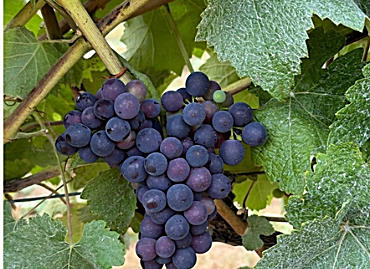
One of the most important jobs this month is bunch sampling.
We walk through each block and take completely random samples to build an accurate picture of how the grapes are
ripening. To keep things genuinely representative, we choose random numbers for the row, vine an bunch - for
example, row 8, vine 14, bunch 5.
It doesn't matter whether that particular bunch looks perfect, slightly behind or even completely green. If it is the one
the numbers lead us to, it goes into the sample.
Once collected, the grapes are tested for pH, sugar level and TA (titratable acidity). Together, these measurements tell
us how the fruit is progressing and, importantly, help us decide when the balance is right for harvest.
Weighing up the crop
Before the samples are crushed and the juice tested, we also weigh them.
Bunch weight gives us another useful piece of information when estimating the eventual harvest. Combined with our
bunch counts and the size of each block, it helps us build a picture of how much fruit we might expect to bring into the
winery.
This year, with the dry conditions potentially influencing berry and bunch size, these measurements are particularly
useful.
Making the cut
September is also the time for green harvesting.
As the grapes move through véraison and towards full ripeness, we'll be looking carefully for bunches that are
significantly behind the rest. Anything that isn't progressing, or shows signs of disease, is removed.
It might seem counterintuitive to remove fruit when we're trying to maximise the harvest, but the aim is quality rather
than simply quantity. By taking away bunches that aren't going to ripen properly, the vine can concentrate its resources
on the fruit that has the best chance of reaching the quality we're looking for.
Getting ready for the big one
And then there is the less glamorous - but absolutely essential - side of harvest preparation.
Crates need cleaning and counting. Harvest scales need calibrating. Snips need sharpening. Tractors, trailers and
other equipment need checking. Paperwork needs preparing so that every load can be tracked by variety, block and
weight because, once harvest begins, things move quickly.
The timing will ultimately be dictated by the grapes themselves. We won't pick simply because the calendar says
October. We'll be watching the sugar, pH and acidity closely and waiting for that point when everything comes into
balance. After such an extraordinary summer, we're expecting that moment to arrive earlier than usual.
A vintage to watch
There is already plenty of excitement around the 2026 English vintage. WineGB has described the national outlook as
optimistic, with growers reporting good ripening, healthy vineyards and clean fruit after an exceptionally sunny and dry
summer.
Of course, the final weeks can always change the story. Rain, temperature and conditions at harvest will all play their
part. But for now, the vineyard is looking promising - and September is our final stretch before the most important few
weeks of the year.
Harvest is coming and, this year, it looks like it might arrive sooner than we think!
VISIT US
Copyright (C) 2026 Bride Valley Wines LTD. All rights reserved.
You were subscribed to the newsletter from Bride Valley Vineyard. Bride Valley is part of the Electric Pub Company
group.
Our mailing address is:
Bride Valley Wines LTD Bride Valley Vineyard Litton Cheney Dorchester, Dorset DT2 9GE United Kingdom

A Tribute to Steven Spurrier
Vineyard Journal September 2026
The 50th Anniversary of The Judgement of Paris
A tribute
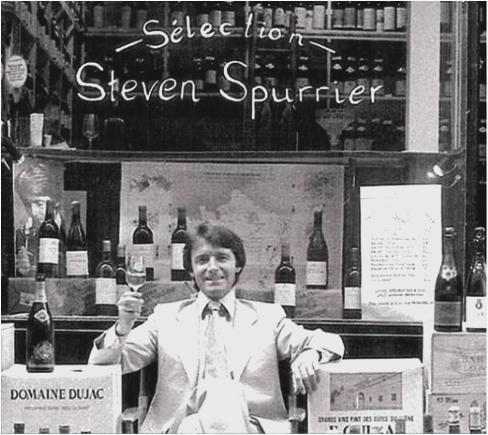
From Bride Valley Vineyard, Dorset - in honour of the 50th Anniversary of the Judgement of Paris, and of our vineyard founder,
the late Steven Spurrier
There is a particular kind of courage that asks uncomfortable questions. It refuses to accept that the way things have always
been done is the same as the way things must always be done. Steven Spurrier had that courage in abundance - and on the
24th of May, 1976, he changed the wine world forever.
What Steven organised that spring afternoon in Paris began, in his own words, as something of a historical footnote: a modest
tasting to mark the American Bicentennial, arranged at the InterContinental Hotel by a British wine merchant who had made
his home and his name in the French capital. He had founded L'Académie du Vin, France's first private wine school, and run
his shop, Les Caves de la Madeleine, from the heart of Paris. He was, by any measure, a man of the French wine
establishment. And yet it was precisely that insider status that gave him the idea.
Steven assembled nine of France's most respected palates - sommeliers, critics, educators, winemakers - and set before
them two flights of wine: California Cabernet Sauvignons alongside the finest Bordeaux, and California Chardonnays
alongside Premier and Grand Cru White Burgundies. The judges were asked to taste blind. The assumption, shared by almost
everyone in that room, was that the exercise would confirm what everybody already knew: that the greatest wines in the world
came from France.
They did not anticipate what came next.
The results shocked the wine world. The Stag's Leap Wine Cellars 1973 Cabernet Sauvignon was awarded the highest score
among the reds, placing above the famous Château Mouton-Rothschild and Château Haut-Brion. The 1973 Château
Montelena Chardonnay took the highest honour among the whites. The judges, all French, all distinguished - had, with their
own scores, handed victory to wines from California.
The only reporter present that day was George Taber of Time magazine, who had attended largely because it had been a slow
news week. He promptly revealed the results to the world. The horrified leaders of the French wine industry responded by
banning Steven from their prestigious tasting tour - apparently as punishment for the damage his tasting had done to their
former image of superiority. It was, perhaps, the finest inadvertent tribute they could have paid him.
The Judgement of Paris was not simply a competition. It was the moment an entire philosophy cracked open. For generations,
fine wine had been understood to be a European - more specifically, a French - inheritance. Origin was assumed to be destiny.
The great châteaux of Bordeaux and the domaines of Burgundy were not merely producers; they were the definition of what
wine at its finest could be. The unexpected victories of California in Paris demonstrated, for the first time, that wines from the
New World could defeat some of the most prestigious estates in France in a blind tasting judged by French experts
themselves.
The landscape that followed was extraordinary. California's wine industry stepped onto the world stage overnight. Investment
flooded into Napa Valley. Winemakers from France travelled west to understand what was happening in those sun-warmed
hillsides. The conversation about what made a great wine - soil, climate, ambition, technique, terroir in its fullest sense -
opened up to the entire globe. Australia, New Zealand, South Africa, Argentina, Spain, Italy beyond its classic regions: all
found new confidence, new markets, new possibility. The old hierarchies did not collapse, but they were joined by something
new - the understanding that greatness was not the exclusive property of any single place.
It is no coincidence, as Steven himself observed, that the first vintage of Opus One - the landmark collaboration between
Robert Mondavi and Baron Philippe de Rothschild - was 1979. The Judgement had made the conversation between the Old
World and the New not just possible, but desirable. France and California were no longer adversaries. They were, at last,
colleagues.
Steven never claimed the Judgement had been a grand plan. He was characteristically modest about it, writing that it seemed
to have had a much bigger effect on most everyone else than on him. But he remained its custodian with grace, correcting the
record when it was distorted, and participating in the landmark 30th anniversary retastings - simultaneously in London and
Napa - where, to the astonishment of those who had predicted French redemption, the Californian wines were not humbled by
age, but proven by it. The winning wine on both sides of the Atlantic was the Ridge Monte Bello 1971, with California
occupying four of the next positions before the highest-ranked Bordeaux appeared in sixth.
The Judgement had passed its own test of time.
50 years on from the Judgement of Paris, we raise a glass here in the Dorset hills. We raise it to a tasting that rewrote the
map of the wine world. We raise it to the curiosity and the courage that made it happen.
And we raise it, above all, to Steven.
Copyright (C) 2026 Bride Valley Wines. All rights reserved.